
News
A New 90-Day Standard for America's Bases
The Pentagon is preparing every major military base in the continental United States to keep running on its own for at least 90 days if a major war or attack cuts off outside help. Each base would be expected to keep its electricity, water, fuel and communications working without the civilian systems it normally depends on. The goal is to keep aircraft flying, command centers running and troops ready even if the power grid or supply lines are knocked out.
The 90-day standard was reported on October 25 by reporters who reviewed Pentagon planning documents. That same day, the Pentagon's chief spokesman, Sean Parnell, confirmed the reporting on social media. The standard goes further than the program's original promise of independent electricity, extending self-reliance to water, fuel and communications as well. Parnell put the reasoning plainly: “We don't want to rely on standard civilian municipal infrastructure to run our national defense. We just simply can't. It's an intolerable risk.”
What FORTRESS Means and What It Covers
The 90-day requirement is part of a program called FORTRESS, which stands for Federal Operations for Resilience, Troop Resources, Energy, Supply and Survivability. Secretary of War Pete Hegseth announced it on September 30 in his “State of the Force” speech at Marine Corps Base Quantico in Virginia. He signed the memo establishing the program the same day, made it effective immediately and described it as the nation's insurance policy.
The memo builds the program on five main parts:
- Energy independence: Bases would make and deliver their own electricity, so a failure of the public power system would not shut them down.
- Supply chain and defense industry strength: The military would protect the routes and factories that supply its equipment, reducing the risk that one broken link stops the flow of goods.
- A strategic defense reserve: The military would stock deep supplies of what it needs so it could keep going through a long emergency.
- Hardened bases and computer security: Bases would be better protected against physical attack, sabotage, drones and hackers, with backup plans to keep leaders in charge if systems are hit.
- Protected satellites and radio signals: The military would guard the satellite links and airwaves it uses to see, find its way and talk, including when GPS signals are jammed.
How Bases Would Make Their Own Power
Electricity is the first priority. At a roundtable with reporters on October 20, a senior defense official said the Pentagon is moving first on energy, starting with assessments of each base's power needs. Officials are studying roughly 500 bases in the continental United States, and the official said solutions would be fitted to each base rather than one design for all.
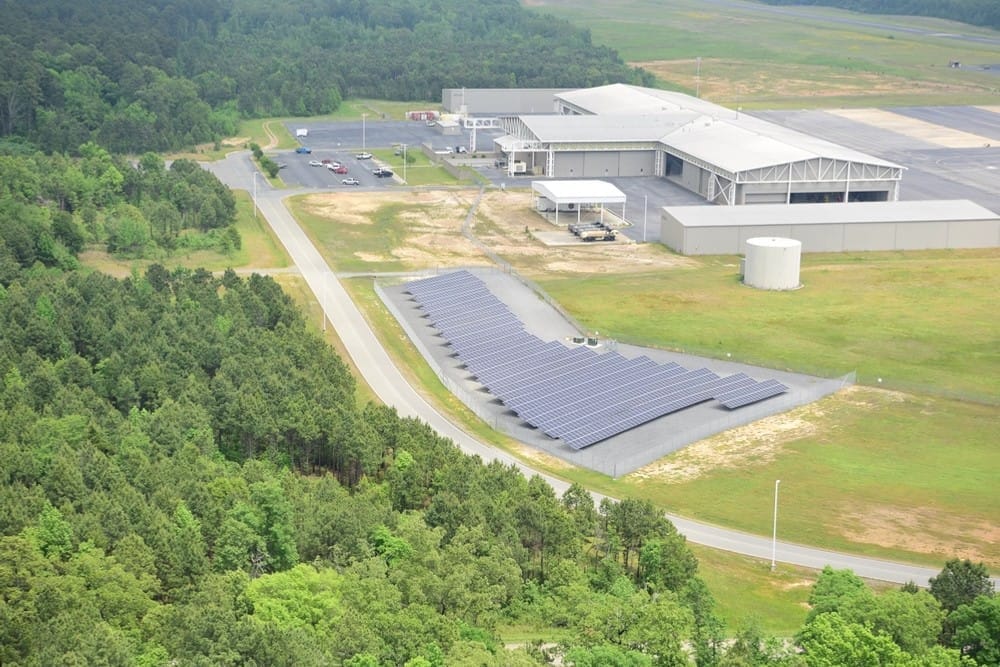
The plan envisions portable nuclear reactors, large banks of batteries and microgrids. A microgrid is a local power system that serves one base and can break away from the public grid during an outage, so the base keeps its electricity even when the surrounding area loses power. The official said a base's mix could also include natural gas, solar power and geothermal energy. Hegseth described the aim in his September speech: “Every major military installation in America is going to generate its own power, independent of the civilian grid. If an adversary takes down the grid - by cyberattack, by sabotage, or by any means - our bases stay lit. Our aircraft keep flying. Our command centers never go dark.”
Bases Already Lined Up for Small Nuclear Reactors
Some of that work is already underway. In August 2026, the Army named the first five bases that will host small nuclear reactors, called microreactors, under its Janus program, along with the companies that will build and run them:
- Fort Bragg, North Carolina, with Antares Nuclear
- Fort Campbell, Kentucky, with BWXT Advanced Technologies
- Fort Hood, Texas, with General Atomics Electromagnetic Systems
- Fort Benning, Georgia, with Radiant Industries
- Fort Drum, New York, with Westinghouse Government Services
The reactors range from about 1 to 20 megawatts and are due over the next five years, with at least one expected to be running by September 30, 2028, to meet a deadline set by President Trump. Private companies will own and operate them under Army oversight, and any nuclear waste must be removed within two years of a reactor shutting down. Jeff Waksman, a senior Army official for installations and energy, explained their role: “These reactors are not going to provide 100% of the power on any of these installations.” Instead, they are meant to power a base's most critical facilities if the grid fails. The Army expects more than 20 such reactors to eventually be built at military bases. The Air Force also began work in 2022 on a project to build a microreactor at Eielson Air Force Base in Alaska, and more may go to Buckley Space Force Base in Colorado and Malmstrom Air Force Base in Montana.
Stockpiles and Factories Ready to Switch
FORTRESS also calls for reserves of munitions, fuel, critical minerals, electronics, spare parts and medical supplies. How much of each would be stored would depend on how fast it is used up in a major conflict and how long factories would need to replace it. For the military's most important needs, the program requires at least two qualified sources or production lines, so the loss of one factory or supplier would not halt operations. “We are building long-overdue strategic reserves, deep enough to fight through disruption,” Hegseth said in his September speech.
Through the Civil Reserve Manufacturing Network, an existing effort now folded into FORTRESS, the Pentagon plans to identify ordinary commercial factories that could switch to making defense goods in a crisis. Technical specifications, computer security protections, contracts and step-by-step conversion plans would be worked out ahead of time instead of after trouble starts. The program also calls for regular industrial stress tests and practice drills to see whether manufacturers could keep production going through long disruptions.
Who Is Running the Program
The September 30 memo gave the Pentagon 30 days, until October 30, to set up a FORTRESS America Program Office reporting to Michael Duffey, the under secretary in charge of buying and maintaining military equipment. On October 6, Duffey named Richard “Matt” O'Malley as interim director to track progress and coordinate the effort, with a two-star military advisor to be appointed to help him. Duffey also ordered eight senior Pentagon officials, including the secretary of the Air Force and the comptroller, to name representatives to work directly with O'Malley's office. Parnell, who has been reported as leading the initiative, says he created it, and a U.S. official described him as the mind behind the program in his role as a senior advisor to Hegseth.
The Pentagon has not given a final timeline, and a senior defense official has said some parts could take years to complete. The first work on power for America's bases, however, is already moving forward.
* The appearance of U.S. Department of War (DoW) visual information does not imply or constitute DoW endorsement.
Join the American Association of Retired Republicans today!
Dues are $12 per year. Member benefits:
✅ Ad-Free Website Viewing
✅ Advocacy for Republican Seniors
✅ Member Only Newsletters
Dues are $12 per year. Member benefits:
✅ Ad-Free Website Viewing
✅ Advocacy for Republican Seniors
✅ Member Only Newsletters