
News
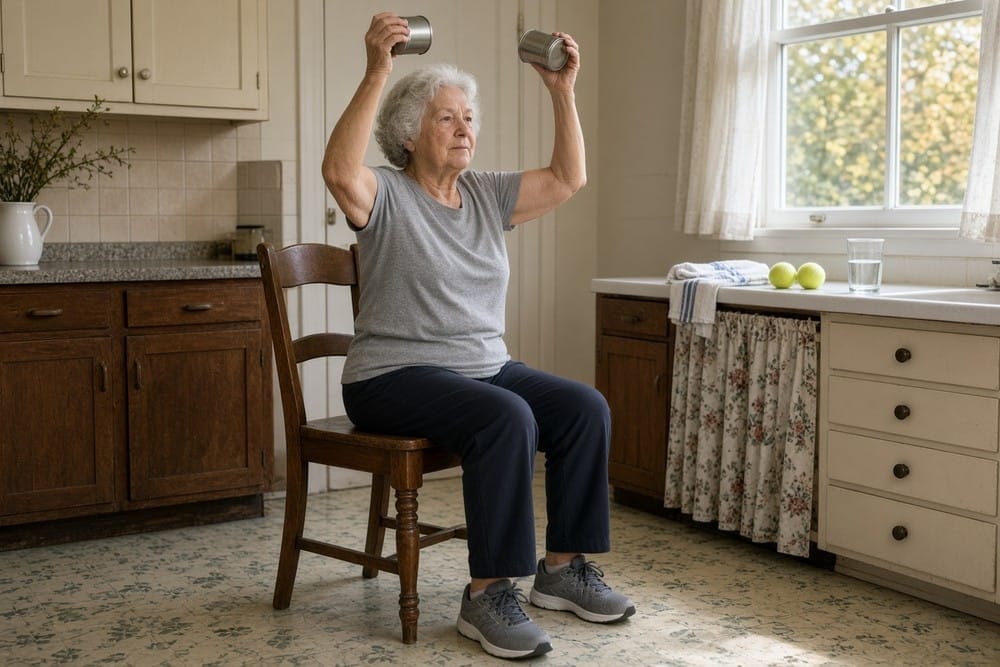
Adults 65 and older do not need a gym, a trainer, or heavy weights to build strength. Federal health officials ask them to work their muscles at least twice a week, and the National Institute on Aging's beginner routine calls for a sturdy chair, a towel, two tennis balls, and a pair of soup cans. A beginner can start with one light session a week.
What Strength Training Looks Like at Home
An older adult can build strength in many ways besides lifting dumbbells. The Centers for Disease Control and Prevention and the federal guidelines count lifting weights, working with resistance bands, body-weight exercises such as push-ups and planks, climbing stairs, shoveling snow, digging in a garden, carrying heavy groceries, and some yoga postures.
Over a week, a person should work all the major muscle groups: the legs, hips, back, abdomen, chest, shoulders, and arms. Each exercise strengthens only the muscles doing the work, so someone who wants balanced strength needs a variety of movements.
How Much Is Enough
The Department of Health and Human Services set the standard in the guidelines it published in 2018: adults 65 and older should do strength exercises at least twice a week. Unlike walking or other aerobic exercise, strength work has no set number of minutes. Instead, federal health officials ask people to judge by effort. A person does each exercise until another repetition would be difficult, and eight to twelve repetitions make one set. One set of each exercise is enough to build strength, and two or three sets may do more.
Older adults should also judge effort against their own fitness rather than a fixed standard. On a scale where sitting still is zero and the hardest possible effort is ten, a person working at a moderate level feels a five or six. Someone who has been very inactive can use that scale to find the right level, and the guidelines say it is a better guide for older adults than any fixed standard.
Starting Slowly After Years of Sitting
Someone who has been inactive should begin more gently. In the guidelines' words, inactive people should "start low and go slow": begin with lighter activity and increase how often and how long over weeks and months. For strength work, a beginner can start with as little as one day a week at light or moderate effort, grow to two days and later perhaps more, and raise the effort a little each week until the work feels at least moderately hard.
People who are out of shape may need months to build up to two full sessions a week, and those who build up gradually lower their risk of injury. Anyone whose routine is interrupted by an illness should resume at a lower level and work back up. Small amounts still count: the Office of Disease Prevention and Health Promotion notes that even five minutes of physical activity has real health benefits.
A Beginner's Routine From the National Institute on Aging
The National Institute on Aging lays out a full session for people just starting or returning after a long break in its Workout to Go program. A beginner needs two tennis balls, a sturdy chair with arms, a towel, and two light objects of equal weight, such as soup cans or water bottles.
The exerciser opens with about five minutes of warm-up, such as walking, then moves through six strength exercises, each done as one set of ten to fifteen repetitions: squeezing a tennis ball, doing push-ups against a wall, raising light weights overhead, lifting one straight leg behind while holding the chair, lifting one leg out to the side, and rising onto the toes. Beginners may need only one- or two-pound weights. As the exercises grow easier, they can work up to three sets and gradually add weight.
Balance work follows in the same session: standing on one foot while holding the chair, walking heel to toe for twenty steps, and a slow balance walk with the arms held out. The institute keeps the safety advice brief: breathe out on the effort, move smoothly without jerking or locking the joints, and stop if something hurts. It also tells beginners to try new movements without any weight until they feel comfortable, and not to work the same muscle group two days in a row, so the muscles can recover.
Stronger Legs, Steadier Feet
People who strengthen their back, abdomen, and leg muscles improve their balance at the same time, according to both the CDC and the National Institute on Aging, and the Workout to Go booklet notes that its leg and ankle exercises build balance as well. A beginner can turn the chair-supported moves into balance training step by step: hold the chair with both hands, then one hand, then a single finger, then no hands, and once steady, try with the eyes closed.
The National Institute on Aging suggests about three sessions of balance work a week. Federal guidelines recommend that all older adults mix aerobic, strength, and balance work, and the institute notes that a person can combine the three in one session.
Frail older adults benefit too. According to the guidelines, strong evidence shows that frail older adults who stay active improve their walking, balance, strength, and ability to manage daily tasks, and that those who combine the three types of activity three or more times a week gain more than those who do a single type.
When to Check With a Doctor First
Healthy older adults who plan to build up gradually generally do not need to see a doctor before starting, according to the federal guidelines and the National Institute on Aging's 2025 booklet, which describes weightlifting, along with brisk walking and gardening, as safe for most people who build up slowly. The American College of Sports Medicine said the same in a 2020 statement: sending healthy older beginners with no symptoms to a doctor for a sign-off first is unnecessary and only gets in the way of starting.
People with chronic conditions should talk with a doctor first. The National Institute on Aging names arthritis, chronic pain, COPD (a long-term lung disease that makes breathing hard), high blood pressure, osteoporosis (thin, fragile bones), type 2 diabetes, dementia, and excess weight as conditions to discuss before making an activity plan. Someone on blood pressure medicine may need the dose adjusted as activity increases, a person with diabetes needs to watch blood sugar and protect the feet, and a person with osteoporosis should ask what is safe for the bones.
The College of Sports Medicine draws a firmer line for inactive people who already have heart, kidney, or diabetes-related disease, or who have warning signs of heart trouble: discomfort in the chest, neck, jaw, or arms, shortness of breath at rest or with light effort, dizziness or fainting, a racing or fluttering heartbeat, swollen ankles, leg pain that comes on while walking, or unusual tiredness during ordinary activities. Anyone in that group should see a doctor before starting any exercise, however light.
An older National Institute on Aging guide, from 2018, lists more reasons to check with a doctor first: a hernia, recent hip or back surgery, eye surgery or laser treatment, blood clots, joint swelling, foot sores that will not heal, fever with muscle aches, and unplanned weight loss.
People who join a fitness center may be handed the Physical Activity Readiness Questionnaire for Everyone, known as PAR-Q+, which begins with seven general health questions. Anyone who answers no to all of them can exercise without restriction. Anyone who answers yes to any of them goes on to follow-up questions and, in some cases, is advised to see a doctor or a trained exercise professional.
Keeping It Going
As the exercises get easier, the exerciser trades the soup cans for heavier weights, works up from one set to three, and holds the chair with one hand, then one finger, then not at all. People who cannot manage the full amount should be as active as their abilities and conditions allow, the guidelines say, and should avoid an inactive life. As the CDC puts it for older adults, "some physical activity is better than none at all."
Join the American Association of Retired Republicans today!
Dues are $12 per year. Member benefits:
✅ Ad-Free Website Viewing
✅ Advocacy for Republican Seniors
✅ Member Only Newsletters
Dues are $12 per year. Member benefits:
✅ Ad-Free Website Viewing
✅ Advocacy for Republican Seniors
✅ Member Only Newsletters