
News
Invited to Play for the First Time
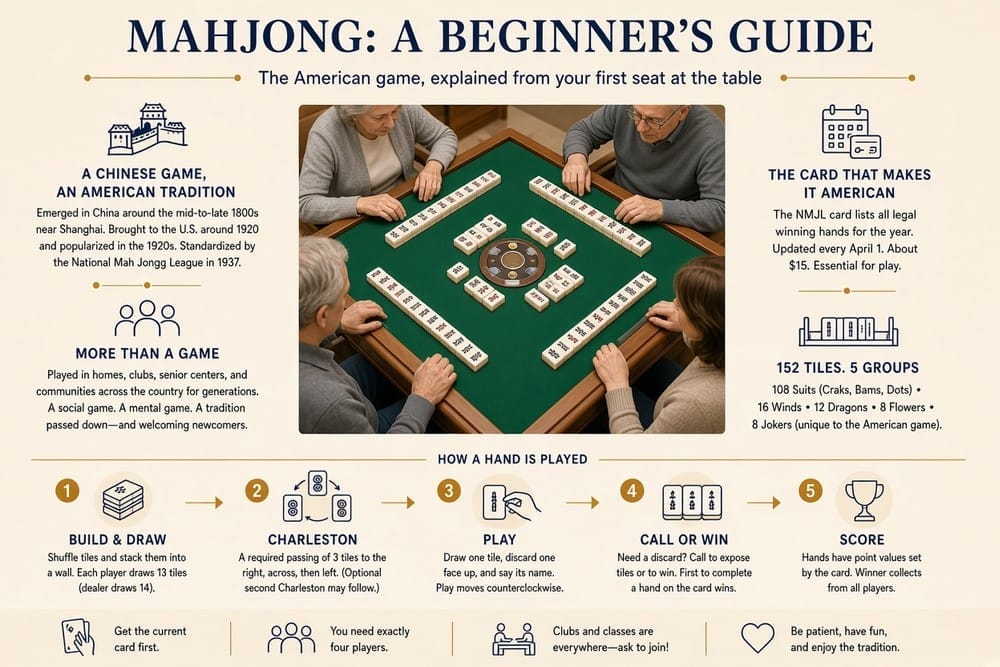
If a neighbor, a friend from church or your daughter-in-law has asked you to fill the fourth seat at a mahjong table, you'll be joining a game Americans have played for more than a century. The National Mah Jongg League, which publishes the American rules, compares it to rummy played with tiles instead of cards. You collect sets of tiles, and the first player to complete a winning hand takes the round.
Where the Game Began
The League says mahjong came from China, but nobody knows exactly how it began. One story says it was a secret game of Chinese royalty, and another says a Chinese general invented it to entertain his troops during long campaigns. Newer research, the League adds, suggests it grew out of card games in China only about 150 years ago.
Historian Annelise Heinz of the University of Oregon says it started out as a gambling game around Shanghai in the mid-to-late 1800s. Around the turn of the century it was mostly men who played, often for money, and late in the Empress Dowager Cixi's reign the game caught on at the imperial court in Beijing. After World War I it became a favorite in Shanghai's social clubs, where more and more Americans were playing it too.
How Mahjong Came to America
Some of those club players started selling the game in the United States. Heinz writes that the best known was Joseph Park Babcock, who represented Standard Oil and brought the game to California in 1922, pitching it as an exciting new pastime. Sellers billed it as an ancient game of the Chinese court, though Heinz says many people in America's Chinatowns knew better.
Before long President and Mrs. Harding were playing, along with Hollywood celebrities and ordinary Americans, and many Chinese Americans took up the game in the 1920s as well. As different groups began inventing their own combinations of tiles, players grew confused about the rules, so in 1937 some devoted players met in New York City to agree on one set of hands and rules for everyone. They founded the National Mah Jongg League at that meeting, and it started with 32 members.
Jewish women passed the American game from friend to friend and played it in the Catskills, and in the fast-growing suburbs of the 1950s a weekly game became routine in many of their homes. More recently, the 2018 film Crazy Rich Asians helped get younger people interested in mahjong again. Today the League counts more than 350,000 members.
The Card That Makes the American Game Different
The League lists several ways the American game differs from the international one, starting with the card. Every game is played using the winning hands printed on the League's card, which changes every year. The American game also uses more tiles, including Jokers, and it opens with the Charleston, when players pass along tiles they don't want.
Every player needs a copy of the current card. It lists every winning hand for the year, grouped into categories such as 2468 or Winds and Dragons, and shows the tiles each hand needs and what it's worth. The League puts out a new card every spring, for use from April 1 through the following March, and it costs $14, or $15 in large print.
The 152 Tiles
An American set has 152 tiles in five groups. There's no need to memorize them before you play, since most beginners know them all after a few sessions.
- 108 suit tiles in three suits called Craks, Bams and Dots, each numbered 1 through 9, with four of every tile
- 16 Winds: North, South, East and West, four of each
- 12 Dragons: Red, Green and White, four of each, with the White Dragon often called Soap
- 8 Flowers, which are used as part of regular hands
- 8 Jokers, which the international game doesn't use
A Joker can take the place of any tile in a group of three or more. It can't be used in a pair or as a single tile.
How a Game Is Played
The tiles are shuffled face down and stacked into a wall. Once the wall is broken, each player takes 13 tiles and the dealer takes 14, and you stand yours on a rack so no one else can see them. Then comes the Charleston. Everyone plays the first one, passing three unwanted tiles to the right, then three across the table, then three to the left. A second Charleston, passing left, across and right, is optional, and any player can stop it before it starts. After that, you can agree with the player across from you to trade up to three more tiles.
Play then moves counterclockwise. On your turn you draw a tile from the wall, then discard one face up in the middle of the table and say its name out loud. If another player throws out a tile you need, you can speak up and take it even though it isn't your turn, as long as it finishes a group, which you then set out face up on your rack, or completes a winning hand. A tile that would only make a pair usually can't be claimed this way unless it wins the game.
When your tiles match a hand on the card, you call out Mahjong, and the other players check your hand against the card. If it doesn't match, your hand is dead and you sit out the rest of the round. If the wall runs out before anyone wins, the round is a wall game and counts as a draw. Each hand on the card is worth a set number of points, with harder hands worth more, and the winner collects from the other three players.
What You Need to Get Started
Buy this year's card first, then think about tiles. An American set comes with all 152 tiles, four racks and usually a carrying case, and sets cost anywhere from about $30 to more than $200.
You need exactly four players, and a club is the quickest way to find the other three. Many clubs teach beginners, often for free, and many community centers, libraries, senior centers and Jewish Community Centers hold regular game days where newcomers are welcome. The game is a weekly staple in Florida, Arizona, Texas and California, and searching Meetup or Facebook for mahjong and the name of your city will usually turn up an active group.
At your first game, let the others know you're new, and pick two or three hands from the card to aim for before play starts. Take your time, since everyone at the table was a beginner once, and by your third game the moves will start to come naturally.
Join the American Association of Retired Republicans today!
Dues are $12 per year. Member benefits:
✅ Ad-Free Website Viewing
✅ Advocacy for Republican Seniors
✅ Member Only Newsletters
Dues are $12 per year. Member benefits:
✅ Ad-Free Website Viewing
✅ Advocacy for Republican Seniors
✅ Member Only Newsletters