
News
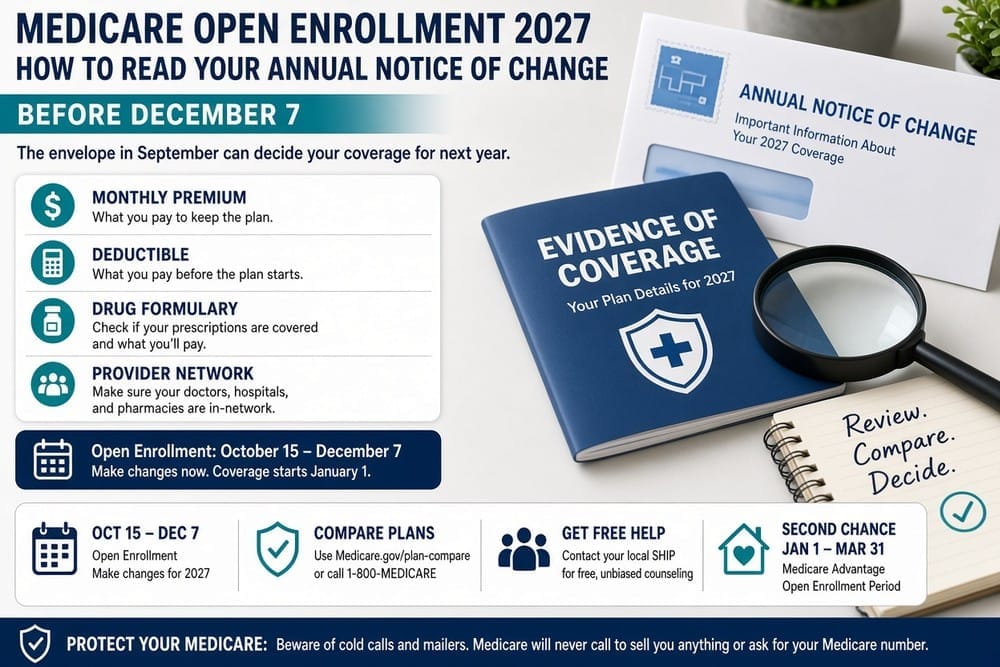
The Annual Notice of Change
Your Medicare health or drug plan sends you a notice in September. The Centers for Medicare & Medicaid Services calls it the Annual Notice of Change, and its purpose is "to tell you about upcoming changes in your Medicare health or drug plan's coverage, costs, and more." Plans also send an Evidence of Coverage. The Evidence of Coverage spells out what the plan covers and what you pay.
CMS says people in a Medicare health or prescription drug plan should always review the materials their plans send them. Plans are allowed to change their terms from one year to the next.
Premiums, deductibles, drugs, and networks
The notice covers changes to your coverage and your costs. The first is the monthly premium, the amount you pay just to keep the plan. The second is the deductible, the amount you pay out of your own pocket before the plan begins to pay its share. The third is the drug formulary, the list of prescriptions the plan covers. A medicine covered this year can be dropped next year, moved to a costlier tier, or restricted. The fourth is the provider network, meaning the doctors, hospitals, and pharmacies the plan works with. Plans can add and drop providers from one year to the next. The doctor you rely on may no longer be in the network.
CMS says Medicare health and drug plans can make changes each year, things like cost, coverage, and what providers and pharmacies are in their networks.
Open Enrollment dates
Medicare's Open Enrollment runs from October 15 to December 7, 2026. Any change you make takes effect on January 1 of the next year. Your plan must get your enrollment request by December 7. Information about next year's plans becomes available beginning in October.
What you are allowed to change
During Open Enrollment you can:
- Join, drop, or switch to another Medicare Advantage Plan, with or without drug coverage, or add or drop drug coverage.
- Switch from Original Medicare to a Medicare Advantage Plan, or move from a Medicare Advantage Plan back to Original Medicare.
- Join, drop, or switch to another Medicare drug plan if you are in Original Medicare.
If you switch to Original Medicare, you may need to join a separate drug plan. You may also want Medicare Supplement Insurance, known as Medigap, to help pay your share of the costs. Medicare cautions that there are limits on when you can add Medigap.
What happens if you do nothing
If your current plan is still being offered and you are satisfied it will meet your needs next year, Medicare says you don't need to do anything. Your coverage continues under next year's terms. In some cases a plan leaves the Medicare program entirely. Medicare sends separate non-renewal notices when that happens, and in that situation you will need to choose a new plan to keep your coverage.
What is different for 2027
In an April 2, 2026 final rule, CMS wrote the Inflation Reduction Act's Part D changes into regulation for 2027 and later, but they were in force well before that. The coverage gap phase is already gone, cost sharing already ends once you reach the catastrophic phase, and the Manufacturer Discount Program replaced the older Coverage Gap Discount Program back on January 1, 2025.
In 2027 your out-of-pocket costs for covered Part D drugs are capped at $2,400, which is up from $2,100 in 2026, and once you reach that limit you pay nothing for covered Part D drugs for the rest of the year. The negotiated prices for the fifteen Part D drugs in Medicare's second cycle of price negotiation also take effect on January 1, 2027.
CMS published preliminary Part D figures on July 28, 2026. The national base beneficiary premium for 2027 is $41.33. CMS describes that as the starting point for calculating a plan's basic drug premium. What you pay is the plan's own premium, which can be higher or lower. CMS said then that final average premiums, and the full list of plans for 2027, would follow in mid-to-late September.
If you buy a standalone drug plan rather than getting your drug coverage through a Medicare Advantage plan, CMS is ending the Part D Premium Stabilization Demonstration at the end of 2026. That was a voluntary program, started in 2025 and meant to keep standalone premiums steadier while the redesigned drug benefit settled in. CMS says plan sponsors have now had enough experience with the new design that it is no longer needed, so premiums for those plans in 2027 are set without it.
Compare plans, or call SHIP
The plan comparison tool at Medicare.gov compares plans side by side. Enter the prescriptions you take and it estimates your monthly and yearly cost for each plan. You can also call 1-800-MEDICARE, or find the plans listed in the back of your Medicare & You handbook.
Medicare points people to the State Health Insurance Assistance Programs, or SHIPs, which it describes as state programs that get money from the federal government to give local health insurance counseling to people with Medicare. SHIPs aren't connected to any insurance company or health plan. Their counseling is free and personal, covering your rights, billing problems, how Medicare works alongside other insurance, and where to find help paying your costs.
The Medicare Advantage Open Enrollment Period
If you are already in a Medicare Advantage Plan and change your mind after the fall deadline passes, the Medicare Advantage Open Enrollment Period runs from January 1 to March 31. During those months you can switch to another Medicare Advantage Plan, with or without drug coverage. You can also drop the plan and return to Original Medicare. If you do, you can join a separate Medicare drug plan.
Marketing rules and fraud
Under Medicare's marketing rules, plan representatives cannot come to your home uninvited. They cannot call unless you are already a member or gave permission. They cannot ask for payment over the phone or online, because the plan must send you a bill. Plans don't need your personal information to give a quote.
Do not give your Medicare card, Medicare Number, Social Security card, or Social Security Number to anyone except your doctor or people you know should have it. Medicare will never call to sell you anything, and never visit your home. If you suspect fraud, you can call 1-800-MEDICARE.
Join the American Association of Retired Republicans today!
Dues are $12 per year. Member benefits:
✅ Ad-Free Website Viewing
✅ Advocacy for Republican Seniors
✅ Member Only Newsletters
Dues are $12 per year. Member benefits:
✅ Ad-Free Website Viewing
✅ Advocacy for Republican Seniors
✅ Member Only Newsletters